
Fixing the Farm Crisis
How American Farmers Became Serfs of the State, and How to Fix It.

Farmers are in a world of hurt.
Their ability to remain profitable is being attacked on three fronts.
Input costs, interest rates, and commodity prices.
Almost every input cost is up. From seeds and fertilizer to tractors, fuel, and labor, farmers are paying dramatically more than they were 5 years ago.
Higher interest rates are also making it harder to finance their operations.
And with commodity prices back to where they were nearly a decade ago, paying these higher prices feels nearly impossible for today’s farmer.
In this article, we’ll briefly look at the causes of the modern farm crisis. Then we’ll evaluate how Bitcoin-backed finance offers something the state and traditional banks can’t: the chance for farmers to exit a rigged game and build financial independence.
The Rigged Game
Similar to farmers in medieval times, who toiled long hours in return for protection from the king, today's farmers toil long hours on the land to serve the interests of the State.
Essentially, our farmers have become pawns in a larger geopolitical game.
Their masters… the U.S. government and large corporate entities… have created an environment where the small- to mid-sized farmer has little if any leverage.
You see… As a nation, our significant trade deficit… driven largely by a lack of domestic manufacturing… has made cash crops one of the primary means by which we attempt to maintain any semblance of balanced trade.
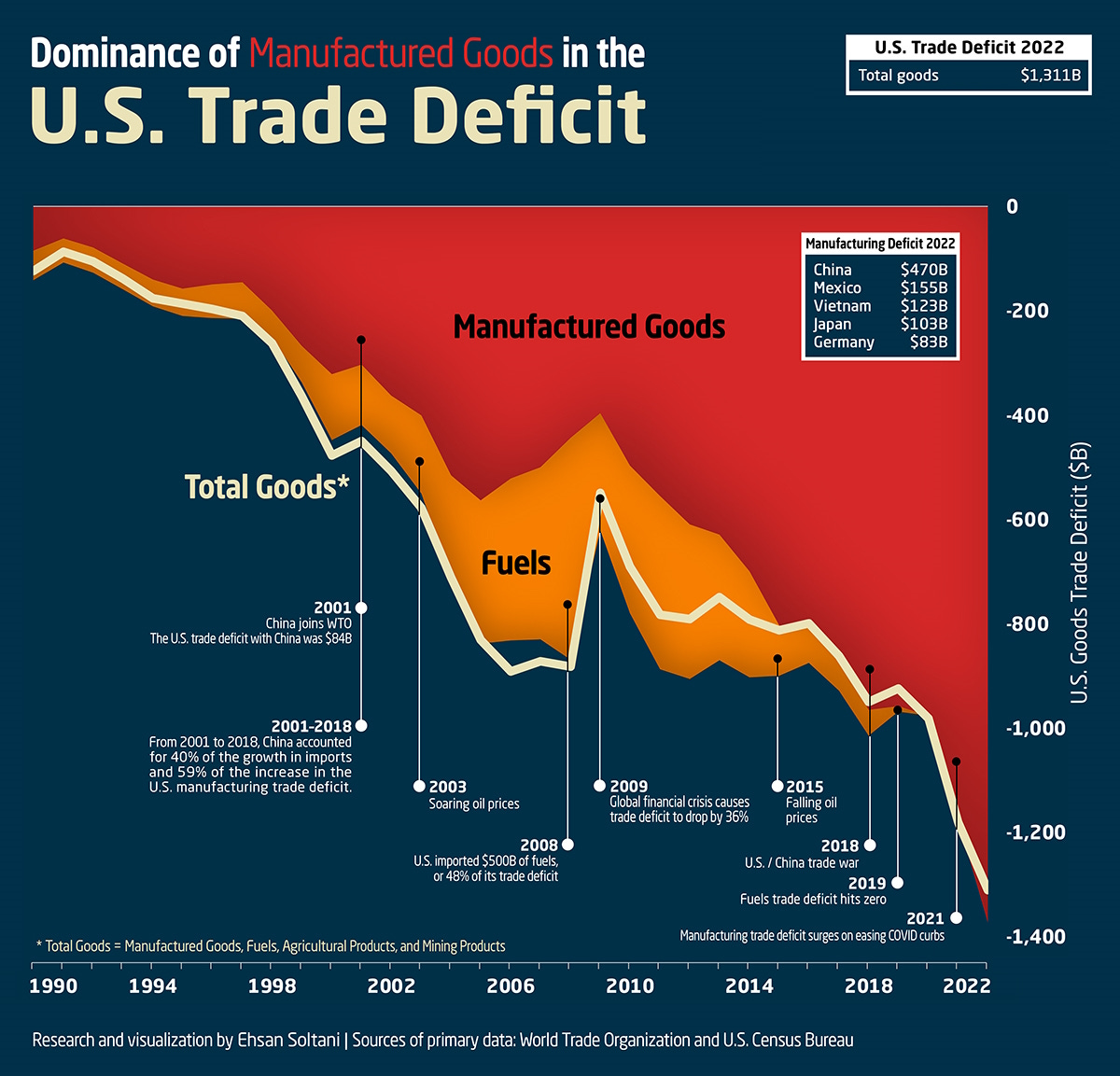
Farmers today are more or less forced by government intervention (subsidies & insurance schemes) to grow already oversupplied commodities on the global market: corn and soy.
The result… Farmers have little pricing power because global markets are so oversupplied.
Most work 80+ hour weeks with little hope of breaking even after subsidies.
Furthermore, vertical integration, with monopolistic entities like Bayer-Monsanto on the bottom and Walmart and Tyson on the top, ensures that whatever profit farmers might have is squeezed on both ends.
Lastly, almost every farming operation is dollar-denominated. Farmers, unlike their government counterparts, can’t print dollars to fund their operations.
As the government continues to print dollars into oblivion, farmers are left to suffer the inflationary consequences.
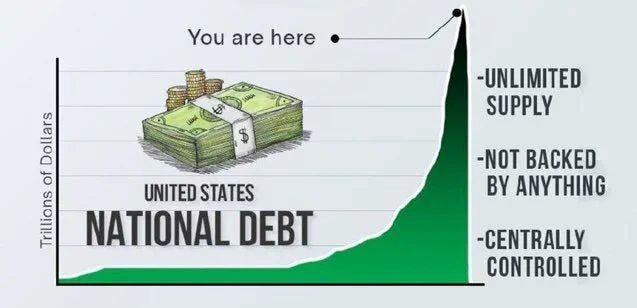
And the consequences are profound… Seed, fertilizer, diesel, and equipment costs have skyrocketed over the past decade.
Today, more dollars are required to plant the same acre… which becomes a losing venture as corn and soybean prices are back to where they were a decade prior.
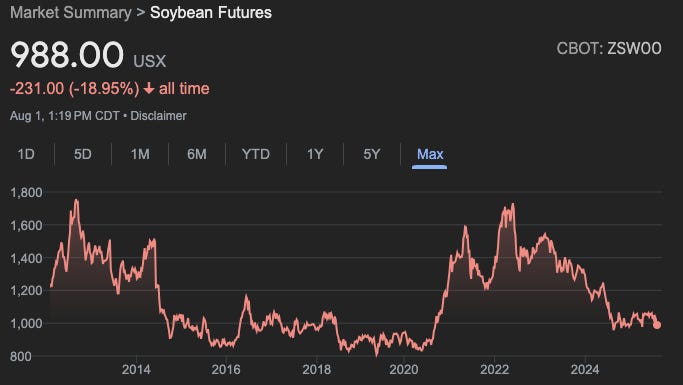
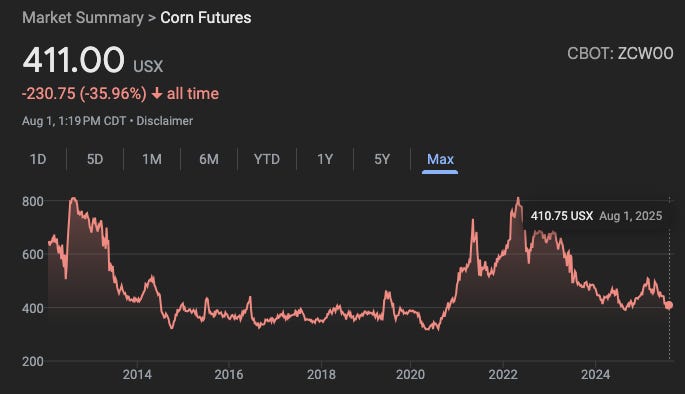
According to reporting from Bloomberg Law, farm bankruptcies, filed under Chapter 12 of the U.S. bankruptcy code, rose sharply in 2024... a 55% increase compared to the previous year… and filings are continuing to trend upward in 2025.
It’s clear that farmers need a new tool in the toolshed. They need a free-market hedge to break the stranglehold of their state and corporate overlords.
Enter…
Bitcoin-Backed Loans.
Bitcoin is the king commodity.
Its price is uncorrelated with corn and soy.
Bitcoin’s supply is perfectly price-inelastic.
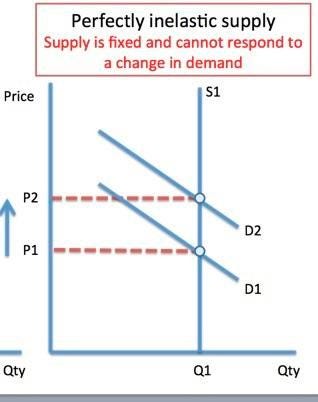
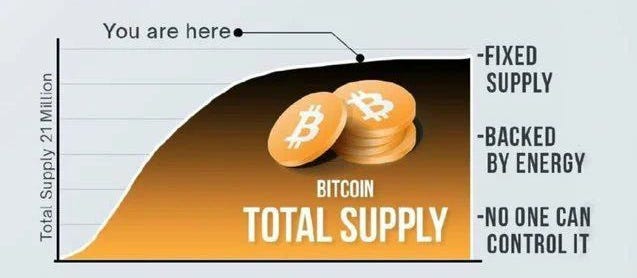
And unlike every other commodity… Bitcoin’s supply is finite…
Meaning… it isn’t something that governments can print, distort, tariff, or manipulate.
In a system where almost everything is manipulated… from subsidies, crop prices, insurance payouts, and even land values… Bitcoin is outside the system, which makes it the perfect hedge.
And the thing is... loans with a relatively small percentage of the total held in Bitcoin can drastically outperform traditional loan structures.
Bitcoin’s average annual return over the past 5 years is ~60%, and its average annual return over the past 10 years is ~84%.
Those are quite aggressive returns…
But for the sake of demonstration, in our hypotheticals, we’ll assume more conservative returns…
In the case of two farmers, one using a traditional loan and the other using a loan structured with Bitcoin, we’ll demonstrate that the incorporation of Bitcoin offers superior outcomes.
Hypothetical #1
To make the math simple, let’s assume that Farmer 1 takes an interest-only loan of $10M at 6.5% interest for 10 years.
At the end of the 10 years, the total cost of the loan is $16.5M.
On the other hand, Farmer 2 takes an interest-only loan of $11M at 6.5% interest for 10 years. The additional $1M is converted into Bitcoin and held in escrow for 10 years.
For the additional $1M, Farmer 2 will pay $650,000 more in interest over 10 years.
Next, assume a very conservative compound annual return for Bitcoin: let’s say 30%.
After 10 years, the end value of the initial $1M in Bitcoin = $13,786,000
The loan, $11M, plus interest, $7,150,000, equals $18,150,000 over 10 years.
However, once you subtract the Bitcoin gain of $12,786,000… The farmer only owes $5,364,000 at the end of the loan.
After 10 years, Farmer 2 is in a better financial position than Farmer 1 by more than $10M.
Hypothetical #2
Now let’s assume that Bitcoin has a compound annual return of 40% over 10 years.
In this case, for Farmer 1, the total cost of the loan over 10 years is still $16.5M.
But for Farmer 2, his $1M allocation to Bitcoin has appreciated to a value of $28,925,500.
The loan stays the same: $11M principal, plus interest, $7,150,000, equals $18,150,000 over 10 years.
The Bitcoin gain, $27,925,500, minus the total cost of the loan, $18,150,000, equals a $9,775,500 surplus.
Yes. You read that correctly. Farmer 2 paid off the loan entirely and still had a surplus of $9,775,500 solely from Bitcoin appreciation.
And these hypotheticals for financing utilizing Bitcoin are becoming a reality.
Companies like Battery Finance are pioneers in the space.
In the future, Bitcoin-backed financing options, where the appreciating Bitcoin is held in escrow, will become a powerful asset for farmers to grow their capital base.
When priced in Bitcoin, the prices of everything related to farming (land, fertilizer, machinery, etc.) are falling, and farmers who denominate their operations in Bitcoin see abundance, not scarcity.
It’s a form of capital that has zero maintenance cost, and, due to its finite supply, it allows farmers to protect and grow their purchasing power over time.
Ultimately, Bitcoin-backed loans have the potential to break the stranglehold of the State and Big Ag on rural America and transform the American farmer from a passive recipient of subsidies back into an entrepreneur, steward, and innovator.